
Packaging Printing Process - Molding and Assembly
Packaging forming and assembly are the terminal processes of packaging production. Forming involves folding and bonding the die cut and pressed substrate into a three-dimensional packaging structure. Assembly involves combining components such as the box body, lining, and labels to form a final product packaging that can be directly used. The core is to ensure structural stability and appearance regularity.
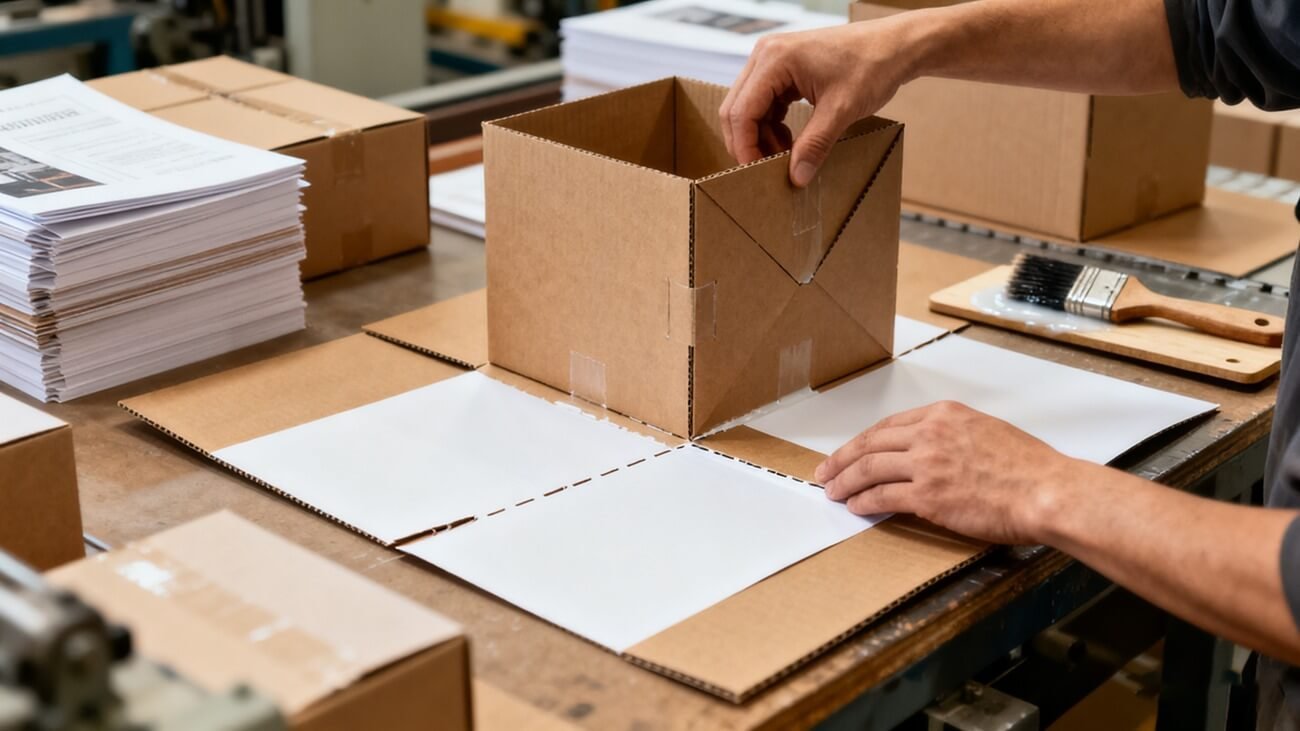
Core process logic
Forming is "shaping": relying on fold lines to fold the substrate, fixing the structure through bonding, interlocking, and other methods, forming basic forms such as boxes and bags.
Assembly is a 'combination': installing auxiliary components (lining, partitions, labels, handles, etc.) onto the foundation structure to enhance packaging functionality.
The two are closely connected, and some processes can be integrated (such as automatic molding and assembly machines), while others require manual assistance (such as high-end customized gift boxes).
Core process types and applications
1. Packaging molding
Specific type: Folding adhesive
Technical features: Fold along the indentation line, fix the interface with glue/hot melt adhesive, high efficiency
Application scenarios: Express cardboard boxes, food packaging boxes, daily necessities cardboard boxes.
2. Buckle molding
Specific type: No adhesive required, fixed through slot and buckle structure splicing, recyclable.
Application scenarios: gift boxes, toy packaging, foldable storage boxes.
3. Hot forming
Specific type: Plastic substrate is pressed and molded after heating, suitable for irregular structures.
Application scenarios: Snack vacuum packaging, electronic product trays.
Packaging assembly
1. Manual assembly
Specific types: manual installation of lining, labeling, assembly of components, suitable for complex customization.
Application scenarios: high-end cosmetic gift boxes, luxury packaging.
2. Automated assembly
Specific type: The robotic arm completes lining placement, label pasting, and handle installation with fast speed.
Application scenarios: beverage packaging and express bags produced in large quantities.
3. Modular assembly
Specific type: Splitting and packaging into multiple modules, forming them separately and combining them, with high flexibility.
Application scenarios: Packaging of cultural and creative products, customized gift boxes.
Core Quality Requirements
Structural stability: There is no glue opening at the bonding area, no looseness at the fastening area, and the load-bearing test meets the standard (such as stacking 3 layers of cardboard boxes without deformation
Dimensional accuracy: After forming, the length, width, and height tolerances are ≤± 0.3mm, and the assembled components are fitted without looseness or offset.
Neat appearance: straight creases, no wrinkles, flat label pasting without bubbles, component alignment without skewness.
Functional compliance: Smooth opening and closing (such as the lid opening and closing without jamming), adequate protection (the inner lining fits the product without shaking).
Common faults and solutions
Opening after molding: The reason is improper selection of glue and insufficient amount of glue applied. The solution is to select specialized adhesive (such as white adhesive for paper and hot melt adhesive for plastic) to match the substrate type, and adjust the amount of adhesive applied to evenly cover the interface.
Assembly component offset: The reason is inaccurate positioning reference and component size deviation. The solution is to calibrate the positioning device and strictly control the machining tolerances of the components.
Wrinkles and folds: The reason is due to abnormal moisture content of the substrate and uneven folding pressure. The solution is to control the moisture content of the substrate at 8% -12% and adjust the folding equipment pressure to be uniform.


