
Packaging and Printing Processes - Vacuum Forming
The packaging vacuum forming process is a plastic packaging process that involves heating plastic sheets, using vacuum adsorption or pressure to adhere to molds, and cooling them to form customized shapes. Its core is used to produce vacuum formed boxes, shells, inner trays, etc. It has the advantages of protection, transparency, and cost.
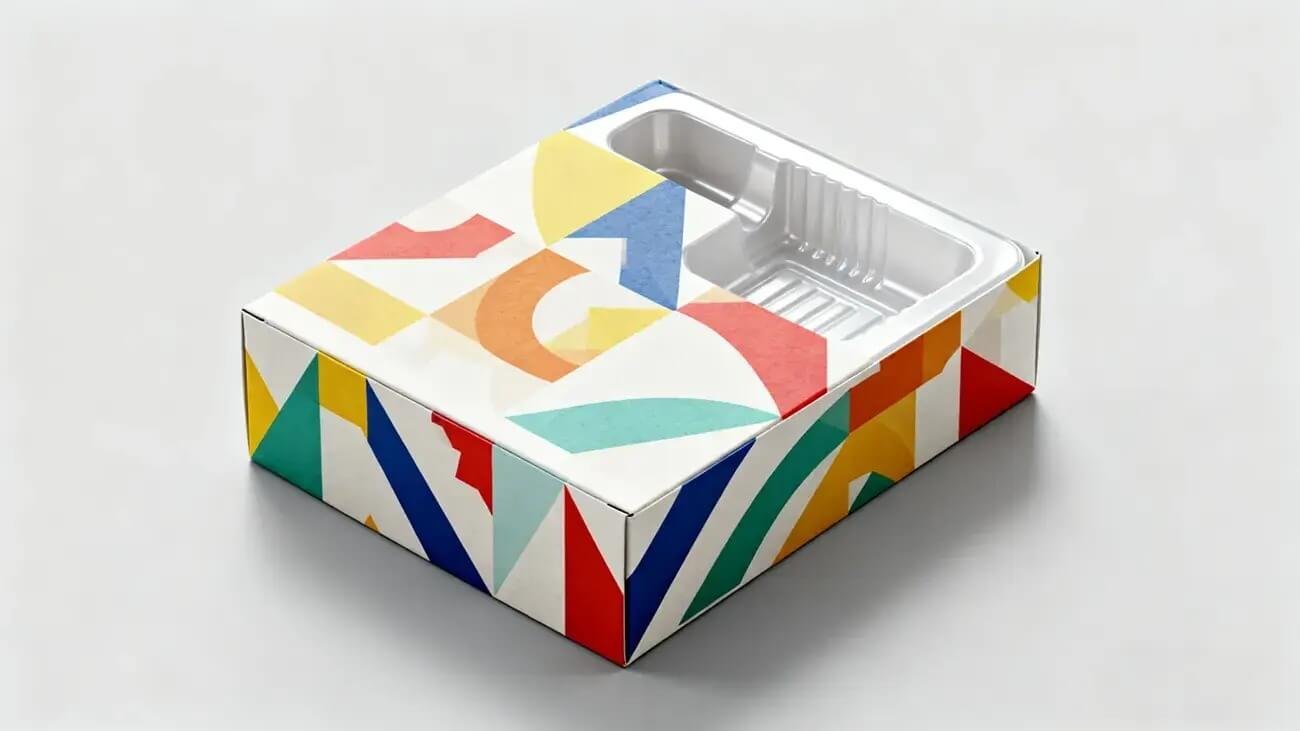
Core Process Principles
Cutting plastic sheets (customizing width and thickness according to packaging dimensions).
The sheet is heated in a heating furnace to a softened state (temperature 120-180 ℃, adjusted according to the material).
Softening the sheet and bonding it to the mold, completely bonding the sheet to the mold cavity through vacuum adsorption or pressure.
Cooling and shaping (natural cooling or air cooling), after the sheet hardens, it separates from the mold.
Cutting and trimming, removing excess edges and corners, to obtain finished vacuum formed packaging.
Core process types and characteristics
1. Vacuum vacuum forming (mainstream)
Features: Relying on vacuum adsorption molding, low equipment cost, high efficiency, suitable for flat or simple curved surface packaging.
Application scenarios: food inner tray, electronic product blister box, daily necessities blister.
2. Pressure vacuum forming
Features: Stacked air pressure assisted molding, suitable for complex curved surfaces, deep cavities, or thick sheet packaging, resulting in fuller molding.
Application scenarios: high-end cosmetic liners, packaging of large household appliance accessories.
3. Concave convex mold vacuum forming
Features: The upper and lower molds are combined with pressure molding, with high precision and neat edges, suitable for packaging with high-precision requirements.
Application scenarios: Medical blister packs, precision electronic component liners.
4. Thick sheet vacuum forming
Features: Made of 2-10mm thick sheet material, with high strength after molding, suitable for turnover packaging and display racks.
Application scenarios: logistics turnover blister trays, supermarket product display shelves.
Key elements: materials and equipment
1. Common sheet materials and their characteristics
PVC: High cost-effectiveness, good transparency, easy molding, suitable for packaging ordinary food and daily necessities (note: cannot be used for high-temperature food).
PET: environmentally friendly, non-toxic, high temperature resistant, strong barrier properties, suitable for food and pharmaceutical packaging (such as beverage bottle liners, pill blister packs).
PP: Good toughness, low temperature resistance, microwave heating, suitable for cold chain food and hot beverage packaging inner tray.
PS: Strong rigidity and high transparency, suitable for packaging electronic products and toys (such as headphone vacuum boxes).
PETG: Environmentally friendly, odorless, resilient, recyclable, suitable for high-end food and cosmetics packaging.
2. Core equipment parameters
Types of vacuum forming machines: semi-automatic (suitable for small batches), fully automatic (suitable for large batches, including feeding, heating, forming, and cutting integration).
Heating temperature: 120-180 ℃ (PVC lower, PET/PP higher).
Vacuum degree: ≥ 0.08MPa, ensuring that the sheet is tightly adhered to the mold.
Molding time: 5-30 seconds (adjusted according to packaging complexity and sheet thickness).
Core advantages and limitations
Advantage
Low cost: High utilization rate of sheet materials, short mold production cycle, low cost, suitable for mass production.
Strong protection: It can achieve dust-proof, moisture-proof, anti-collision, and more precise protection according to the product contour.
Good visualization: Transparent blister packaging can visually display products and enhance purchasing desire.
Lightweight: More lightweight than traditional paper boxes and injection molded boxes, reducing logistics costs.
limitation
Only applicable to plastic materials, prone to deformation in high temperature environments.
The difficulty of forming complex deep cavity packaging is high, and the scrap rate may increase.
Common faults and solutions
Incomplete molding: The reason is insufficient heating temperature and vacuum degree. The solution is to increase the heating temperature by 5-10 ℃, check the sealing of the vacuum system, and ensure that the vacuum degree is ≥ 0.08MPa.
Surface scratches/bubbles: The reason is impurities on the surface of the sheet and excessive heating. The solution is to clean the sheets and molds, reduce the heating temperature or shorten the heating time.
Edge cracking: The reason is uneven thickness of the sheet and insufficient cooling. The solution is to use uniformly thick sheets, extend the cooling time, or enhance the air cooling effect.


